
Situatie
Strong security basics are the backbone of any organization’s ability to reduce risk and demonstrate responsibility. Companies are expected to put proper technical and organizational measures in place to protect the confidentiality, integrity, and availability of data. At the core, this means:

Solutie
Payment integrity
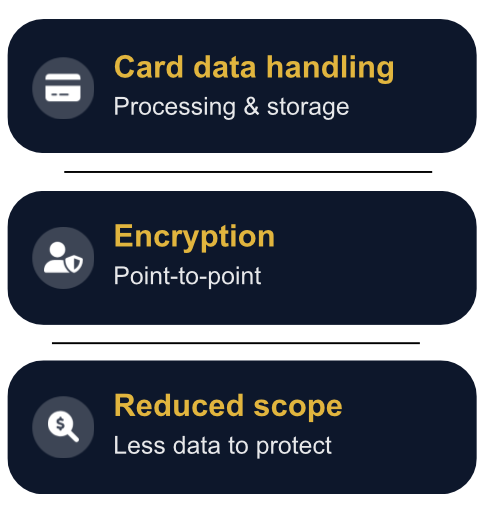 Any event technology platform that handles credit card payments must adhere strictly to the Payment Card Industry Data Security Standards (PCI DSS). This global information security standard is designed to prevent fraud by protecting how payment card data is processed and stored.
PCI DSS compliance provides a non-negotiable baseline of technical and operational requirements. Platforms must undergo regular audits by PCI qualified auditors, such as those compliant with PCI DSS 3.2, to maintain rigorous data security standards and assure clients that cardholder information remains safe. Furthermore, implementing Point-to-Point Encryption (P2PE) is a key mitigation strategy, as it devalues sensitive data at the point of entry and significantly reduces the scope of sensitive data stored, thereby mitigating breach fallout.
Auditing, monitoring, and incident response planning
The high cost of US data breaches is heavily influenced by slow detection and escalation times. The operational countermeasure to this vulnerability is a highly functional governance structure:

Security as a competitive differentiator
The ultimate non-negotiable is adopting technology that transforms security from a reactive cost center into a strategic competitive advantage, differentiating the platform as a “trust-first brand”. Decentralized Identity (DID) offers a definitive architectural shift necessary for future security and consumer loyalty.
In a traditional ecosystem, the event technology platform acts as a centralized data custodian, absorbing all the liability associated with massive PII stores. Decentralized Identity (DID) systems fundamentally shift this model by empowering the user (the attendee) to own and control their identity data via a secure digital wallet.
A DID system utilizes Verifiable Credentials (VCs), digital, cryptographically secured representations of identity information, which are stored in the user’s ID Wallet. This model dramatically reduces friction: credentials are issued once, stored by the user, and can be reused across multiple events, eliminating redundant verification checks and creating a trustworthy, consistent authentication process. Institutions that embrace this mindset increase security, reduce risk, and gain loyalty.

DID systems offer a technical solution to the regulatory problem of over-collection. Byusing features like selective disclosure, attendees can prove only the necessary attributes required for entry or service access (e.g., “I am over 18,” or “I am a registered keynote speaker”) without revealing the sensitive, underlying PII such as their full birthdate or home address.
By allowing verifiers to work with a minimal, non-sensitive dataset, selective disclosuregreatly reduces the compliance burden imposed by data minimization principles underGDPR and CCPA. Since major regulatory fines stem from storing and transferring high volumes of centralized PII, DID offers a powerful architectural mitigation strategy, reducing the platform’s attack surface and cumulative fine exposure.
Leave A Comment?