
Situatie
By December, most people are tired.
Tired of full calendars. Tired of uncertainty. Tired of another year that asked a lot from everyone. And yet, this is also the moment when people are most open, to pause, to connect, to feel appreciated. That’s why holiday corporate events matter more than ever.
Today, many employees and clients are being careful with their personal spending. They’re choosing fewer dinners out, fewer trips, fewer “extras.” So when a company chooses to invest in a beautiful, thoughtful end-of-year experience, it feels different. It feels generous. It feels human. It says: we see how hard this year was and we want to celebrate you.
Solutie
In fact, people who truly enjoy their company’s holiday event are 96% less likely to leave the following year. Not because of the music or the menu alone, but because they felt connected. Because for one evening, work felt less like a system and more like a community. Connection changes behavior.
This measurable impact has driven a trend toward strategic investment. Recent analysis reveals that 92% of decision-makers plan to spend the same or more on the 2025 holiday party, with a notable 51% actively increasing their budgets to deliver a superior employee experience.
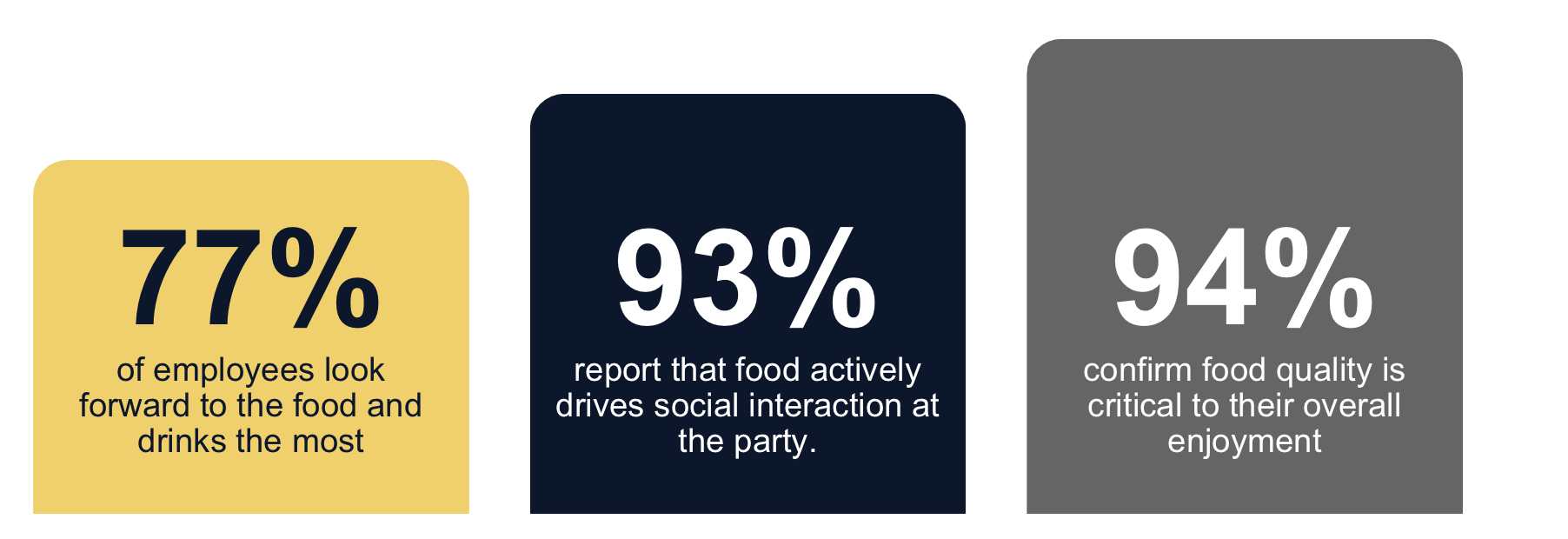
This budget increase represents a strategic organizational recognition that success hinges on the quality of execution and the depth of the experiential design. Given that food quality, for instance, is reported as critical to 94% of employees’ overall enjoyment, increased budgets are necessary to move beyond standard catering toward varied, high-quality, and personalized food formats that actively facilitate social interaction. This validates the strategic pivot towards high-quality execution as a prerequisite for achieving measurable culture and retention goals.

Morale, motivation, and the profit link
Beyond retention, the corporate event delivers immediate returns in staff morale and engagement. A significant 85% of employers believe that Christmas parties positively impact staff morale and keep teams motivated. This foundational boost in morale is the necessary precursor to higher engagement, which in turn correlates directly to financial performance.
Research confirms the deep link between an engaged culture, fostered in part through these social gatherings and superior financial outcomes. Highly engaged business units achieve significant financial superiority, including a documented 20% increase in sales. Furthermore, companies that cultivate a positive, connected culture see remarkable results, with their earnings per share (EPS) reported to be 147% higher than their competitors. Corporate events are a key vehicle for actualizing and visibly reinforcing this high-engagement state. Investing in social cohesion and recognizing achievement is, therefore, not a soft HR initiative but a direct operational step toward improving the bottom line.

The superiority of shared experiences over monetary rewards
The modern workforce assigns a higher intrinsic value to shared memories and experiences than to easily forgotten cash incentives. Analysis of employee preferences reveals a profound value discrepancy: only 22% of employees would prefer a small financial bonus over attending the social experience of a work Christmas party. This demonstrates that employees fundamentally value the social capital, recognition, and lasting memory gained from the event.
This behavioral pattern has a strong psychological underpinning. Research confirms that spending on experiences advances more immediate happiness than spending on possessions. When a company invests in an experience, it creates a lasting positive association with the employer, driving job satisfaction and emotional loyalty.
Furthermore, for the younger demographic, experiential rewards are highly relevant. Millennials and Generation Z, who represent the future of the workforce, are highly motivated by experiences over material wealth. These employees often face economic strains, diverting increasing portions of their income to essential expenses. By receiving an experiential reward, which could be a trip, a unique activity, or a high-end celebratory dinner, the employee can tick something off their “bucket list” without the financial worry, making the appreciation gesture even more meaningful and reinforcing loyalty. Strategic event planners can capitalize on the preference for the party over cash by optimizing their total recognition expenditure, allocating a larger portion to high-quality events that yield a significantly higher psychological return on investment compared to small, taxable, and quickly spent cash bonuses.
The role of food and flow
Food and beverage service are foundational elements of the event’s social infrastructure.
Leave A Comment?