
Situatie
Event budgets often look perfect on paper, but the reality of implementation frequently tells a different story. Statistics show that 65% of event planners experience budget overruns, with an average overspend of approximately 20%. These unplanned expenses are often not truly “unexpected” but are predictable recurring costs that were simply missing from the initial proposal.
To protect your margins and deliver a successful event, you must look beyond the base quotes. Here are the hidden costs you likely haven’t considered.

Solutie
Why “Clean” budgets often fail
To protect the bottom line, one must distinguish between the superficiality of a proposal and the fiscal reality of the final invoice:
- Planned costs: Base venue rentals, standard per-head catering, and primary AV packages.
- Actual expenditures: Mandatory service charges (often 18%), labor overtime, emergency technical upgrades, and post-event disposal fees.
When we evaluate “Margin Leakage”, the uncaptured internal hours and administrative overhead, it becomes clear this is more hazardous than a visible budget overrun. While an overrun is a known deficit, margin leakage is a silent killer; it occurs when a coordinator’s billable time is consumed by stakeholder education or manual data entry that was never factored into the agency fee. This leakage begins with the often-ignored regulatory paper trail.
Where the cracks appear
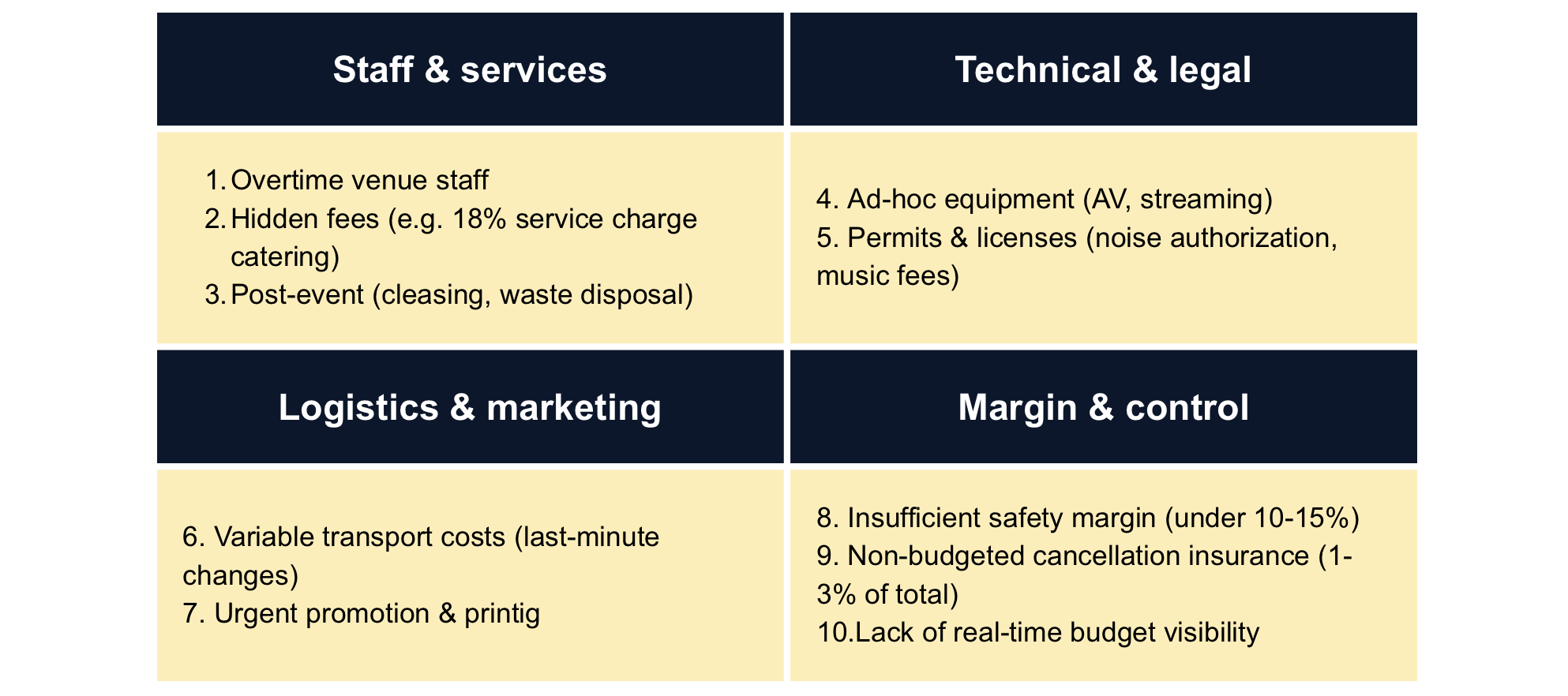
Budget leakage map: Top 10 hidden
The event lifecycle is supported by a “fiscal floor” of regulatory and risk-mitigation expenses that rarely appear in initial venue quotes. These are non-negotiable costs; failure to architect them into the budget creates an immediate 18–20% gap between the estimated and realized spend.
Venue contracts are typically designed as “basic” packages that do not survive contact with high-production requirements. A veteran producer knows that the sticker price is merely a starting point for negotiation.
By analyzing “Standard” versus “Real-world” requirements, we identify the origin of the 27–28% gap in planned vs. actual costs. This is not an accident of planning; it is a predictable outcome of failing to account for the labor required to manage a complex environment.
Modern events demand technical sophistication and “Greening,” both of which serve as a significant “Hidden Labor Tax.” As sustainability becomes a requirement, the associated costs shift from line items to massive billable hour sinks.
An event does not end when the guests leave. The “strip-down” phase is where profit margins are truly won or lost. I categorize these as “predictable but ignored” costs that frequently cause agency failure. Fiscal rigor requires acknowledging that “Client Aspirations”, such as custom peacock themes or specific cushion covers, increase the post-event labor burden exponentially. Agencies that fail to account for this manual labor see their competitive edge evaporate.
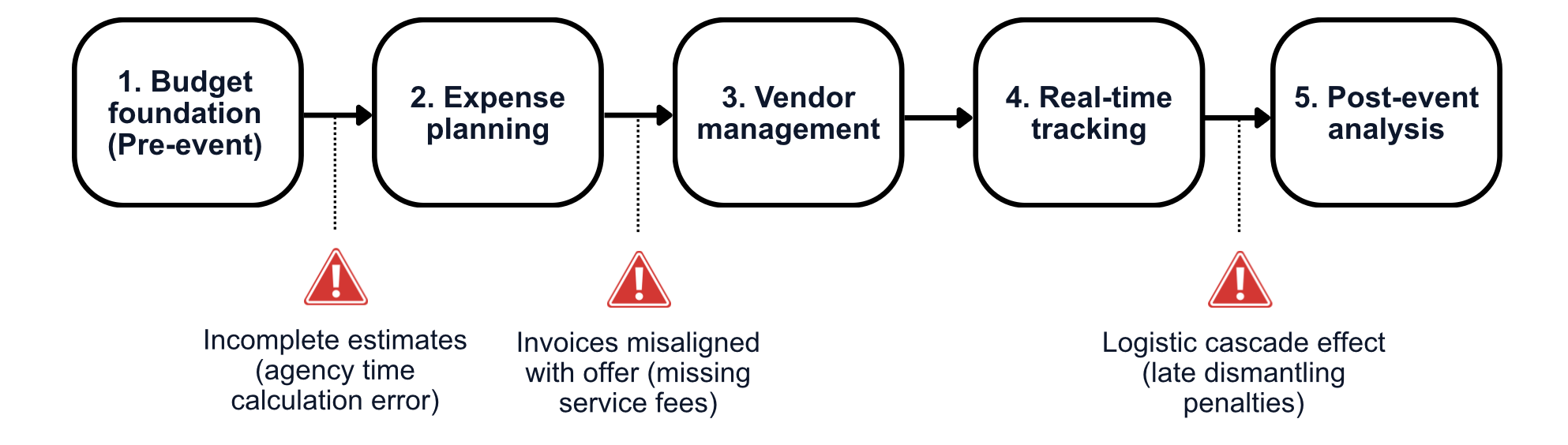
How to protect your budget
Accurate event pricing is based on evidence and meticulous time tracking, not instinct. To transition from “budgeting” to true Financial Architecture, an organizer must protect their margins by identifying every minute of labor and every hidden fee before a contract is signed.
To insulate your event from financial failure, adopt these three critical strategies:
- The 10–15% Explicit Contingency Buffer: This must be a visible line item in the proposal to absorb the 20% average overspend inherent in the industry.
- Real-Time Visibility: Implement centralized tracking to match supplier invoices against budget lines as they occur, catching 18% service charges and overtime before they hit reconciliation.
- Pre-Event Coordination of Post-Event Logistics: Secure transport, disposal, and storage agreements weeks in advance to avoid last-minute premium rates.
Stop “planning” budgets and start architecting them. By anticipating the hidden, you protect the visible and ensure that every event is a masterpiece of both experience and efficiency.
Leave A Comment?