

Soluții
How to enable Kernel-mode Hardware-enforced Stack Protection in Windows 11
[mai mult...]Graded Naming Convention and Documentation
You can easily provide groups of users with unwanted access if you do not use descriptive security group names. For example, the accounting department just purchased a SaaS based accounting program. It can sync with Active Directory for single sign-on and permissions. The administrator created an Accounting_1 and Accounting_2 group to manage access to the software. Accounting_1 is full access and Accounting_2 is limited. Both groups are generic and have no description or documentation.
The accounting department also needs a shared folder setup so they can share and collaborate on some files. The administrator thinks, oh I’ve already got accounting groups configured, and therefore proceeds to use Accounting_1. Users are added to Accounting_1 to provide access to the NTFS share, but unfortunately this now grants users full access to the SaaS accounting program.
Bad Security Group Names
The groups below are examples of bad security group names because there is no description and are generic, telling the administrator nothing. You would have to scan the entire network to know where these groups are being used.

Good Security Group Names
In the examples below you can look at the group name and instantly know what it is used for and there is information in the description box.

Do not create generic security group names, instead be descriptive in their use and use the description field.
[mai mult...]Audit and Review NTFS Permissions
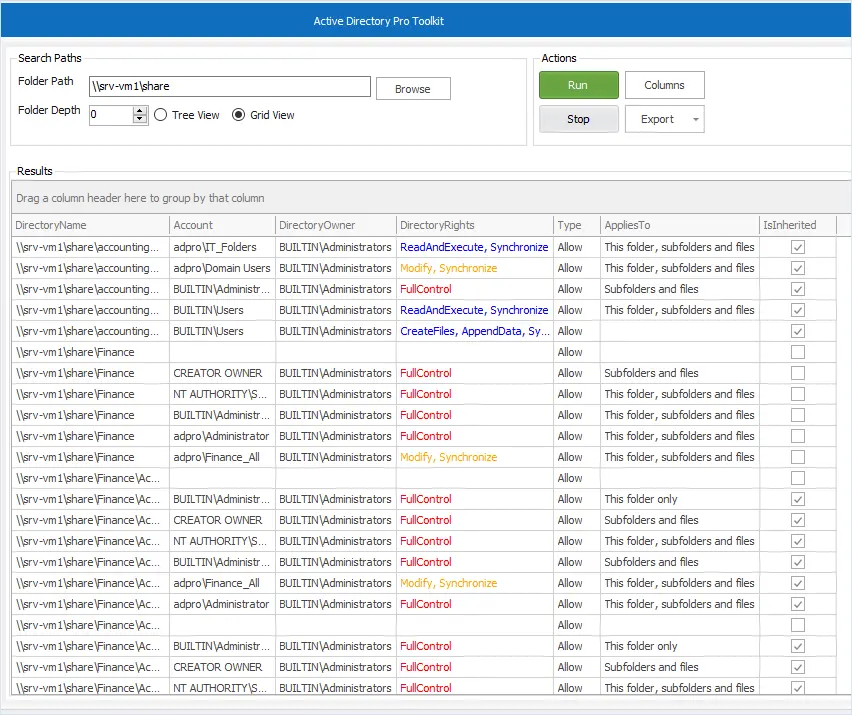
Whether you have an existing file server or are setting up a new one it is important to review your NTFS permissions, this at times can even be a requirement of an audit. To simplify this task I recommend using an NTFS Permissions Report Tool that can scan all folders and show you who has access to what. With a reporting tool, you can list all folder permissions, verify users have the correct permissions, check inheritance, find insecure permissions, verify directory rights, and export the report to CSV, Excel, or PDF.
Secure NTFS Permissions with Security Groups
It is a best practice to create security groups to set NTFS permissions rather than using individual user accounts. Security groups have the following advantages:
- Easier to manage permissions for a group of users
- Easily remove user’s permissions
- Easily grant users access to a file or folder
- Makes it easier to identify who has access to what
- Simplifies auditing and compliance reports
Let me walk through an example of how using security groups simplifies NTFS permissions management.
Say you have 100 employees that need access to the accounting folder, 80 need read/write permissions, and the other 20 need read-only access. To set these permissions you only need to create two security groups, and then configure the permissions for these two groups. Example below.
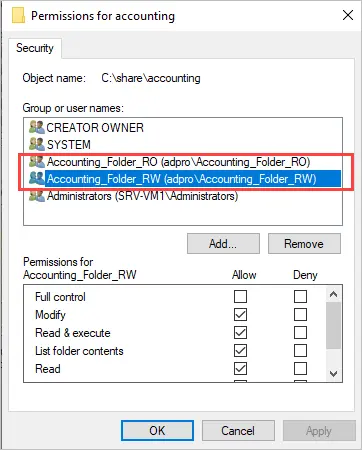
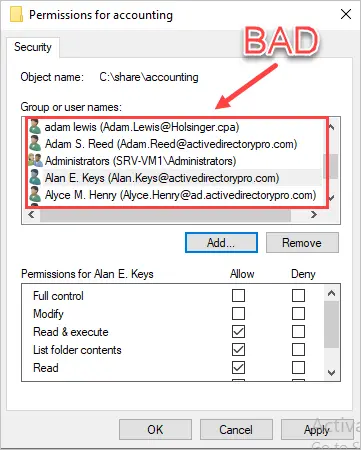
Now as new employees are hired, all you need to do is add the user to one of these groups to give them access. To remove access you would just remove them from the group. If you did not use security groups for the NTFS permissions you would have to add all 100 users to the ACL, this would be very time consuming and difficult to manage. Example below.
What is a TS File?
While using your computer, you might run into a file with a .TS extension. Unlike most extensions that represent a specific kind of data, a file with “.ts” extension can be either a video file or a TypeScript code file. So, what’s the difference between them, and what’s a TS file anyway?
What Is a Transport Stream (TS) File?
The meaning of a TS file depends on what kind of content it holds. For instance, if you come across a TS file while working with videos and DVDs, then it stands for Transport Stream. These files use the MPEG-2 compression algorithm to achieve maximum efficiency and compatibility across various media types, including internet streaming and broadcasting.

You’ll commonly find these files on DVDs, Blu-ray discs, and digital broadcasting systems like DVB, ATSC, and IPTV. The data stored in these files (video, audio, subtitles, etc.) is broken down into small chunks. You’ll have a tiny piece of video, followed by a tiny piece of audio, and then maybe a subtitle chunk. Each of these chunks carries some extra data that helps detect errors within them. This data also tells each chunk when it’s supposed to play.
This way of representing data includes extra information that isn’t useful for storage but has advantages for broadcasting. Since all the data is broken into small pieces, you can send each piece over a connection in real time. And if there’s any error in a chunk, the receiver can use the extra data present in each chunk to detect the error and skip over it.
The most important thing to note is that the receiver doesn’t need the entire stream. It can easily start from anywhere in the middle of the transmission, assemble the data from that point on, and use it in real time.
[mai mult...]How to turn off vanish mode on Instagram
Vanish mode on Instagram is a great way to enhance your safety and privacy while chatting with friends and reduce message clutter. However, it is easy to accidentally turn on Vanish Mode while scrolling through your chat history.
[mai mult...]