
Situatie
If you’re still using Excel’s default layout, you’re making things harder than they need to be. The software’s interface is surprisingly flexible if you know where to look, and making just a few tweaks can turn a standard spreadsheet app into a personalized number cruncher.
Solutie
Enable Dark Mode
Get a more comfortable view for long spreadsheet sessions
Availability: Microsoft 365 for Windows. Other versions support dark themes (ribbon only), but not full canvas Dark Mode.
Staring at a blinding white screen at 8AM is a tough way to start the day. I find that switching to a darker interface reduces eye strain during long spreadsheet sessions.
- Click File and select Account in the bottom-left corner.
- Expand the Office Theme drop-down menu and click Black.
- Head back to the Excel grid, and in the View tab on the ribbon, click Switch Modes to toggle the spreadsheet cells from light to dark.
Dark mode only affects how the UI appears on screen, not your printouts.
Activate and modify the Quick Access Toolbar
Put your most-used tools one click away

Availability: All desktop versions of Excel from 2007 onward.
Whether you like the modern ribbon layout is one thing, but I think we can all agree that “tab hunting” is the ultimate productivity killer. The Quick Access Toolbar (QAT) lets you pin your favorite commands so they’re always visible.
- Right-click anywhere on the ribbon and select Show Quick Access Toolbar. If you don’t see this option, it’s already enabled.
- Right-click any tool you use frequently and select Add to Quick Access Toolbar.
- Click the QAT’s down arrow and select More Commands to reorder your icons
Create a command center tailored to your workflow
Availability: All desktop versions of Excel from 2013 onward.
If you find yourself bouncing between tabs just to finish one task, you should definitely build your own. Creating a custom tab lets you group your “daily drivers” into one place—think of it as a curated toolbox with only the wrenches you actually use.
- Right-click anywhere on the ribbon and select Customize the Ribbon.
- Click the New Tab button at the bottom of the right-hand list. Excel automatically creates a New Tab (Custom) with a New Group (Custom) inside it. You can add more groups to the new tab if you want to.
- Select the new tab and Rename it to reflect how you plan to use it. Do the same with the groups.
- Click and drag commands from the left-hand list into the appropriate custom groups.
- With your custom tab selected, click the Up Arrow on the far right to move it to the top (meaning it’s in the leftmost position on the ribbon). Once it’s there, the arrow turns gray.
If you can’t find a command in the left-hand list, expand the drop-down at the top and select All Commands.
Stop losing your place in massive datasets
Availability: Microsoft 365 (Windows and Mac) and Excel for the web.
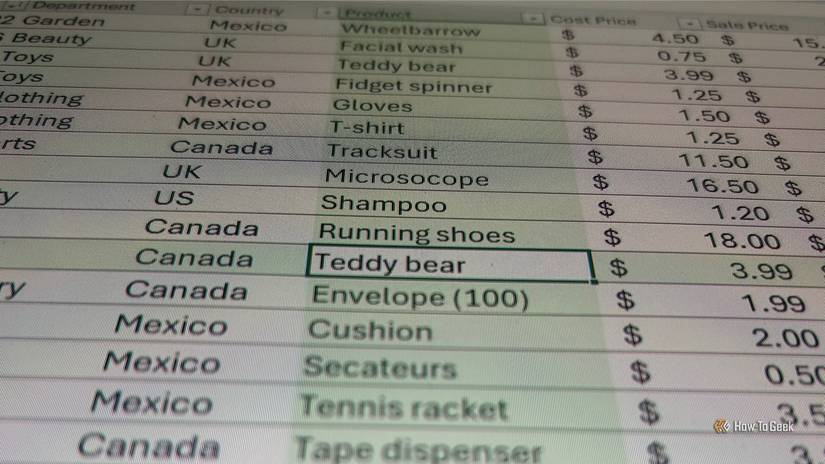
We’ve all been there: you’re looking at row 452, you glance away for a second, and suddenly you find yourself entering data into row 453. It’s an absolute nightmare for data integrity. The Focus Cell features is a total game-changer because it acts like a digital ruler, highlighting the exact row and column of your active cell so you never have to squint at the headers again.
- In the View tab, click Focus Cell to activate the highlighting.
- Expand the Focus Cell drop-down menu to change the Focus Cell Color.
- Check Show Auto-Highlight in the drop-down to make the Find and Replace tool use these highlights.
Press Alt > W > E > F to toggle Focus Cell on and off instantly.
Get instant answers without writing a formula
Availability: All desktop versions of Excel from 2016 onward. Limited options in Excel for the web.
The status bar at the bottom of the Excel window is one of the program’s most underrated features. It’s split into two zones: the left side tracks your current state (like Cell Mode or Accessibility status), while the right side provides real-time AutoCalculate data. By default, this AutoCalculate segment only shows a few basics like Average, Count, and Sum, but you can turn it into a metadata powerhouse that lets you audit your data without writing a single function.
The AutoCalculate data only appears when you select populated cells. Otherwise, the right side of the status bar appears blank.
To get started, right-click anywhere on the status bar at the bottom of your screen.

You’ll see a list of settings you can toggle—here’s what you should activate and why:
- Numerical Count: Activate this to see how many cells in your selection actually contain numbers. This is a lifesaver for spotting numbers stored as text that might be breaking your formulas.
- Minimum and Maximum: Toggle these on to see your dataset’s boundaries at a glance. It’s the fastest way to spot an outlier or verify a column’s range without sorting.
- Sum, Average, and Count: These are usually activated by default, but double-check that they are so you can quickly verify that your complex formulas return logical results.
Click any value in the status bar to copy it to your clipboard.
Adjust the formula bar
Make complex formulas readable and auditable
Availability: All desktop versions of Excel from 2007 onward and Excel for the web.
However, if you find yourself constantly dragging the bar down to read a single, massive line of text, it’s usually a signal that you’re using a suboptimal formula. Instead of struggling with a wall of text, expand the bar and use LET or other modern functions to split your logic into separate lines. This transforms a daunting calculation into a readable, easy-to-audit list of variables.
- Hover over the bottom edge of the formula bar until your cursor turns into a double-headed arrow, then click and drag downward.
- When you type your formula, use Alt+Enter to move each variable or calcutions on it’s own line.
Press Ctrl+Shift+U to instantly toggle between your expanded view and the standard single line.
Leave A Comment?